
Blog
From Scholar’s Desk to Palm of Hand: A Millennium Journey of Wenwan

From Scholar’s Desk to Palm of Hand: A Millennium Journey of Wenwan
Welcome to our world of Wenwan. When you pick up a strand of bodhi seeds and gently twirl them, or caress a piece of warm, aged jade, have you ever wondered about the thousand-year cultural history carried in your hands? Today, let’s travel through time together and explore the legendary journey of Wenwan from the desks of scholar-officials to the palms of the masses.

Origins: The Gentleman Compares Virtue to Jade (Pre-Qin to Wei-Jin Periods)
The seeds of Wenwan were sown in the early childhood of Chinese civilization.
The Era of Ritual Vessels: The jade dragons of the Hongshan culture, the jade cong of the Liangzhu culture—these ancient totems, though serving worship and power, already established the aesthetic paradigm of “using objects to convey meaning.” The Book of Rites states: “A gentleman does not part with his jade without reason.” The jade’s warmth and hardness became symbols of virtue, forming the spiritual source of the later idea that “objects carry moral principles.”

On the left is a jade cong, and on the right is a jade dragon.
The Awakening of the Literati: The Wei-Jin ethos infused soul into collectible artifacts. Amidst frequent warfare, Wang Xizhi and friends floated wine cups along winding streams at the Orchid Pavilion, while Ji Kang played Guangling Melody in a bamboo grove. Scholars began to entrust personal emotions and philosophical reflections to objects—a seal or an inkstone was no longer merely a tool but an extension of personality.
Standardization: The Song Dynasty’s Ultimate Elegance (Tang and Song Periods)
If the Wei-Jin period was a spark of inspiration, the Song dynasty was the comprehensive foundation of collectible artifact aesthetics.
Systematization of the Scholar’s Studio: Emperor Huizong of Song may not have been a wise ruler, but he was a top-tier artist. Under his influence, scholar’s studio treasures became systematic: Li Gonglin collected ancient inkstones, Mi Fu bowed to rocks as his elder brothers, and Su Shi composed poems for agarwood. Zhao Xihu’s Record of Pure Enjoyments in a Mountain Retreat from the Southern Song systematically documented over ten categories of refined objects, including guqins, inkstones, and unusual rocks, establishing鉴赏 standards.
The First Collecting Fever: Around the Grand Xiangguo Temple in Bianjing, China’s earliest antique markets emerged. The rise of epigraphy meant scholars not only appreciated objects but also studied their inscriptions. Ouyang Xiu’s Collection of Antiquity pioneered epigraphy. The distant predecessor of bracelets—prayer beads—also gradually evolved from counting tools to mindful, elegant objects with the popularity of Chan Buddhism’s “living Zen.”
Peak: The Ming-Qing Fusion of Refined and Popular (Ming to Qing Dynasties)
The Ming and Qing dynasties were the golden age of Wenwan. Most categories familiar to us today matured during this period.
Treatise on Superfluous Things and Literati Aesthetics: Wen Zhenheng’s Treatise on Superfluous Things from the Ming dynasty can be called an encyclopedia of Wenwan. He proposed the aesthetic principle: “Rather ancient than contemporary, rather simple than clever, rather frugal than vulgar”—a hidden standard that still guides collecting today.
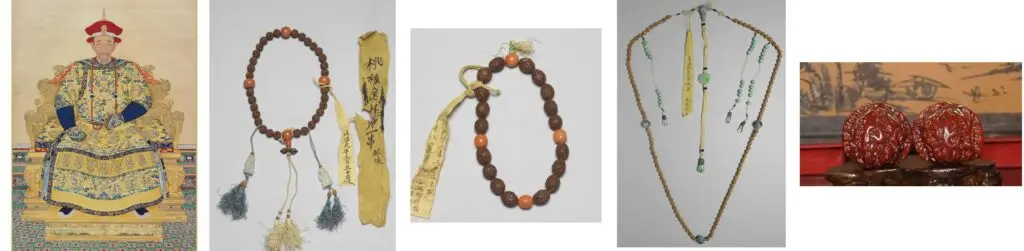
The scholar’s bracelet and walnuts of Emperor Qianlong
The Explosion of Materials:
-
Imperial Splendor: The Qing imperial workshops gathered the finest craftsmen. The thin-walled, luminous jades of Hindustan and the solemn textures of imperial zitan wood reached the pinnacle of craftsmanship.
-
Vitality from the Folk: Jade carving in Suzhou, bamboo carving in Jiading, gourd vessels in Jinling—regional crafts vied for brilliance. Olive pit carvings depicting entire scenes like The Red Cliff Ode within a square inch left viewers in awe.
-
The Standardization of Bracelets: The court bead system popularized bead string culture. With the influence of Tibetan Buddhism, prayer beads composed of bodhi seeds, amber, and turquoise gradually evolved into holding beads combining faith and aesthetics.

The Qing Dynasty Bodhi seed prayer beads in the Capital Museum, Beijing
An Interesting Phenomenon: After the rise of the merchant class during the Ming and Qing dynasties, they sought to “affect refinement” by collecting Wenwan, which objectively promoted the popularization and innovation of craftsmanship. The boundaries between elegance and vulgarity were constantly negotiated and redefined.
Transmission and Rebirth: Circulation from Modern Times to Present
Republican Era Grace: Amidst the flames of war, literati still guarded the sparks of culture. In the studios of Liulichang, Lu Xun hunted for stone rubbings, while Zhang Boju traded his mansion for the Pingfu Manuscript. Wenwan became a spiritual refuge in tumultuous times.
The Contemporary Revival Trilogy:
-
Silent Period (1950s-1970s): Traditional collecting culture was interrupted, with limited trading driven underground to “ghost markets.”
-
Recovery Period (1980s-1990s): The flashlight beams in the pre-dawn Panjiayuan market illuminated the first collecting fever after reform and opening-up. Old objects began returning to the market.

Panjiayuan Cultural Toy Market in Beijing, China
-
Massification Period (21st Century Onward):
-
The Baidu search volume for “文玩” was nearly zero in 2005 but peaked in 2015—a nationwide participation catalyzed by the internet.
-
Bodhi fever, walnut fever, turquoise fever… In rounds of trends, some saw business opportunities, others saw culture.
-
Bracelets:A Microcosm of Collectible Artifacr History
Focusing on the branch of bracelets reveals a clear evolutionary trajectory:
-
Religious Implement → Literati Elegance → Popular Accessory: From the religious solemnity of Tang esoteric prayer beads and vajra bodhi, to the scholarly appreciation of Ming agarwood bracelets, to today’s versatile accessories.
-
Evolution in Material Narrative: Early emphasis on material rarity (ivory, rhino horn) shifted to contemporary focus on cultural depth (the aged patina of moon and star bodhi).
-
Changing Significance of Wearing: From devotional counting and status marking, to today’s personal expression and emotional attachment.
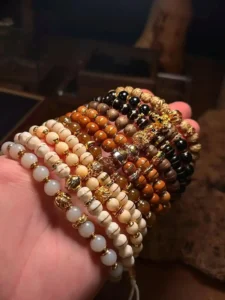
Final Thoughts: Why Do We Still Need WenWan?
In this digital age, Wenwan may seem like a “counter-current.” But perhaps for this very reason, they are more precious:
A Way to Defy Time: The warmth of a piece of jade requires decades of human nurturing; the cracking pattern of a moon and star bodhi strand witnesses seasonal cycles. In an era chasing “instant gratification,” Wenwan teach us the aesthetics of “delayed gratification.”
A Point of Connection: When you rub an aged walnut, you connect not only with the tree’s century of growth but also potentially with the hands of the craftsman and previous collectors. It’s a handshake across time and space.
A Miniature Spiritual Refuge: Within a square inch lies a universe. Appreciating a rock’s “wrinkles, leanness, perforations, and transparency,” or savoring a jade’s “dense, chestnut-like texture,” trains a focused, dialogic way of perceiving the world.
In the universe of Wenwan, there are no pure “new items.” Every object awaits its story; every layer of patina is a poem of time. May you find here that “poem of objects” that belongs to you.
Discussion Topic: What was your first Wenwan? What story lies behind it? Feel free to share your collecting memories in the comments section.


